
 By
Which API version should you use today?
On 5 November we submitted our first DDS through the API to the EUDR test environment using the version 1 service, the one we had built from the WSDL we downloaded when we started. TRACES answered that this API version had been discontinued. We moved to V4 the same day.
If your ERP, your customs software or your software provider submits DDS to TRACES, this is what changes, taken from the official API documentation (version 1.3, 22 September 2026) and from what we saw while migrating.
The version to use is V4. The documentation describes four versions:
- V1, the original, with the original Regulation (EU) 2023/1115: submit and retrieve DDS.
- V2, an update of V1 with more retrieval operations. Both only knew the DDS.
- V3, a redesign driven by Regulation (EU) 2025/2650: new actor types, the simplified declaration for micro or small primary operators, and grouped declarations. New namespaces, operations and structures.
- V4, the current one: keeps V3's operations and data model, removes retrieval of a DDS's content over the API, adds a human-readable reference-number status and a summary address, and widens the simplified declaration's internal reference.
V3 remains available alongside V4 during a transition period, but the Commission says it will be deprecated in a future release and that new integrations should target V4. No date has been published.
What happens to an integration built on V1 or V2?
It no longer works. The documentation says V1 and V2 are decommissioned with the release of V3, because the reform changes the data model and the service contracts in a way that is not backward compatible. Statements submitted before the reform remain readable, read-only, through V3.
If your software provider has not told you anything, ask which version they use. It is a one-line question with a one-line answer.
Sourevo submits it for you in TRACES. Start free in test mode, no card needed. Start free
What changes in the operations?
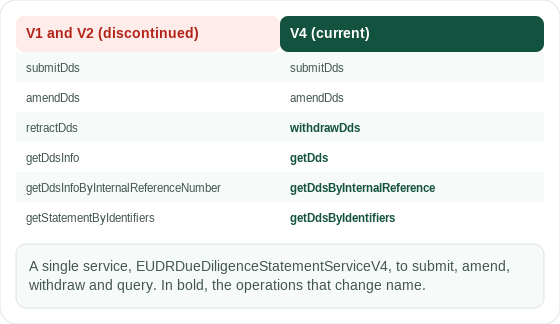
V1 had two services, one to submit (EUDRSubmissionServiceV1) and one to retrieve (EUDRRetrievalServiceV1). V4 has a single one, EUDRDueDiligenceStatementServiceV4, with these operations:
| V1 | V4 | What changes |
|---|---|---|
| submitDds | submitDds | operatorRole replaces operatorType and only accepts OPERATOR or REPRESENTATIVE_OPERATOR |
| amendDds | amendDds | Returns the uuid and the status (for example AVAILABLE) |
| retractDds | withdrawDds | Renamed; returns uuid and status (for example WITHDRAWN) |
| getDdsInfo | getDds | Overview data only; up to 100 UUIDs per call |
| getDdsInfoByInternalReferenceNumber | getDdsByInternalReference | Overview data only |
| getStatementByIdentifiers | getDdsByIdentifiers | No longer returns content: always answers NotFoundException |
The DDS identifier is now called uuid in every request. And there is a new fault, NotFoundException, which TRACES returns in the same way whether the DDS does not exist, the verification number does not match, or you are not allowed to see it. Previously the last case returned a permission error. For your code, “not found” no longer means “does not exist”.
The full content of a DDS can now only be viewed in the TRACES web interface. If your system read statements back from TRACES to fill something in, it has to keep what it sends.
What changes in the data you send?
What takes the most work when migrating:
- The operator is split into fields. Name and address, combined in V1, become operatorName (mandatory) and a structured operatorAddress.
- Identifiers. Only four operator identifier types remain: eori, vat, gln and tin.
- Quantities. Volume is gone; use net mass or the supplementary unit. Net mass now takes 16 digits with 6 decimals, and the supplementary unit is no longer an integer.
- Percentage estimate or deviation. A new field, optional in the schema. In our tests, TRACES required it for domestic statements and refused it for imports; an export statement went through without it on 12 November.
- No traders. The trade activity (TRADE) is gone: traders no longer submit DDS.
- Referenced DDS. associatedStatements becomes groupedDeclarations, with reference numbers, up to 2,000. They can only be set on submission: if an amendment includes them, TRACES answers EUDR-GROUPING-NOT-ALLOWED-ON-AMEND.
- Scientific names of up to 200 characters (previously 100).
Errors come with a code like EUDR-SOMETHING-IN-CAPS inside the fault. The rejections TRACES gave us at submission, with dates, are in our piece on what TRACES rejects when you submit a DDS.
How do you get the status and the reference number?
With getDds (by uuid) or getDdsByInternalReference (by your internal reference). They return an overview: status, reference and verification numbers and, where there is one, a rejection reason or a message from the authority. V4 adds referenceNumberInfo, a text describing the number's state: under system analysis, under competent authority review (Article 17), or assigned.
DDS statuses in V4 include AVAILABLE, GROUPED (when another DDS groups it) and OBSOLETE. The documentation also lists SUSPENDED and UPDATED, but says they are not active in this release: your code must accept them without breaking.
How long to wait: the documentation asks you not to poll at high frequency and recommends waiting at least one hour after submitting before retrieving the reference number, because it may not be available straight away. In our acceptance tests it came sooner, between one and about three and a half minutes, but design your integration around the official recommendation, not around our experience. It also sets limits: 100 DDS per call when retrieving by UUID, 1,000 by internal reference, 5 calls per second per IP and 10,000 per minute overall. And it warns that sustained abuse may lead to the operator's account being suspended.
For clearance this has a practical consequence: submit the DDS with time to spare, not on the morning the customs broker needs the number.
How does a freight forwarder submit for several clients?
The documentation describes two set-ups, and it is worth keeping them apart:
- As an authorised representative. You submit with the role REPRESENTATIVE_OPERATOR and fill in the details of the operator you represent: name, address and an identifier. The client does not need a TRACES account. In our test on 9 November, TRACES required the represented company's address split into street, postcode and city, even though the schema has it as optional.
- With an API user linked to several operators. If an organisation runs several operators under one API user, or a service provider submits on behalf of several operators, each operator needs a Web Service Access Identifier, sent in the BodyIdentity SOAP header of each request. Without that header, if the user is linked to several operators, TRACES rejects the request because it cannot tell which one you are acting for.
Which role fits depends on your relationship with the client and the mandate; see our guide for freight forwarders and customs brokers.
How is each call authenticated?
Every request carries a WS-Security header with a UsernameToken and a password digest, over HTTPS. You never send the Authentication Key itself: you send a digest computed from it, which changes with every call. This is how we build it:
- Generate a random nonce (we use 16 bytes) and put it, Base64-encoded, in the Nonce element.
- Take the current UTC time to the second, for example 2026-11-13T09:15:02Z, for the Created element.
- Compute Base64(SHA-1(nonce + Created + Authentication Key)), with the nonce as raw bytes, not as its Base64 text. That is the Password, with Type PasswordDigest.
- Add a wsu:Timestamp with Created and Expires. We set Expires 60 seconds later, so the server clock matters: if yours drifts, authentication fails even with the right key.
The credentials are an EU Login user plus the Authentication Key that TRACES issues in the “Web Services Access” section of the profile. The documentation stresses that the key is private and that the person behind that EU Login user answers for what is sent. The change log announces mTLS authentication in a later release, with a transition period.
A small but useful addition: V4 responses can carry an EudrUserMessage header with Commission announcements about the EUDR. Log it; it is the channel announcements will come through.
Which WebServiceClientId goes in each environment?
Besides the security header, every request carries a WebServiceClientId header. The documentation says its value is shown in the “Web Services Access” section of your TRACES profile. These are the addresses and the values we use:
| Environment | DDS service | WebServiceClientId |
|---|---|---|
| Acceptance (tests) | https://acceptance.eudr.webcloud.ec.europa.eu/tracesnt/ws/EUDRDueDiligenceStatementServiceV4 | eudr-test (the echo service answers with it) |
| Production | https://eudr.webcloud.ec.europa.eu/tracesnt/ws/EUDRDueDiligenceStatementServiceV4 | eudr-repository, as in the conformance test specification; check your profile |
The echo service, EudrEchoService, sits under the same /ws/ path in acceptance. Keep the client ID and the addresses in configuration, never in code: if the Commission gives you another value, you change a variable and nothing else.
What do the errors look like?
TRACES answers with a SOAP fault of one of three types. BusinessRulesValidationException means the data breaks a rule and brings one or more codes. PermissionDeniedException means the user cannot act for that operator, or the statement is in a status or past a deadline that does not allow the operation. NotFoundException means the statement does not exist, the numbers do not match or you have no access: TRACES gives the same answer for all three.
In V4 the codes come in upper-case kebab case inside an ID element. These are the ones we have hit in acceptance, or that the documentation gives for the cases below:
| Code | When it appears |
|---|---|
| EUDR-OPERATOR-EORI-FOR-ACTIVITY-MISSING | IMPORT or EXPORT by an operator without an EORI on its TRACES profile (5 November) |
| …-PERCENTAGE-ESTIMATION-MISSING | DOMESTIC statement without percentageEstimationOrDeviation |
| …-PERCENTAGE-ESTIMATION-NOT-ALLOWED | IMPORT statement that includes it |
| EUDR-BEHALF-OPERATOR-STREET-EMPTY, EUDR-BEHALF-OPERATOR-COUNTRY-EMPTY | Representative without the represented company's structured address (9 November) |
| EUDR-API-AMEND-NOT-ALLOWED-FOR-STATUS | Amending a statement that is still SUBMITTED (7 November) |
| EUDR-GROUPING-NOT-ALLOWED-ON-AMEND | An amendment carrying groupedDeclarations (documentation) |
| EUDR_API_AMEND_DEADLINE_ELAPSED | Amending after the 72-hour window (documentation) |
Notice the last one: some codes in the documentation still use underscores. Parse both forms, keep the raw code in your logs and show the user a sentence, not the code. The story behind each rejection is in our piece on what TRACES rejects when you submit a DDS.
When can you amend or withdraw over the API?
Only while the statement is AVAILABLE, and within 72 hours of it becoming AVAILABLE. After that, amendDds answers PermissionDeniedException with EUDR_API_AMEND_DEADLINE_ELAPSED, and only an extension from the competent authority, on request, reopens it; otherwise you submit a new DDS.
On 5 November we amended a statement inside the window: TRACES analysed it again, it came back to AVAILABLE straight away and kept the same reference and verification numbers. The date of the statement did not change either. On 7 November we tried to amend one seconds after submitting it and got EUDR-API-AMEND-NOT-ALLOWED-FOR-STATUS: while it is SUBMITTED there is nothing to amend yet.
Withdrawing (withdrawDds) follows the same window and is also blocked if the statement is GROUPED or under checks by the competent authority. An amendment cannot change the activity type. The business side is in the guide on amending or withdrawing a DDS, and what the numbers are for, in the guide on the reference and verification numbers.
Which conformance tests come before production?
To connect to production, the Commission asks you to pass conformance tests in acceptance first. The minimum is four: CF1, connection and authentication (the echo service); CF2, submitting a DDS; CF3, retrieving the reference number from the UUID; and CF4, handling errors when submitting. Amendment, withdrawal and retrieval by third parties are optional.
The documentation recommends testing the integration in acceptance and, once connectivity and authentication work, repeating the process in production. The echo service only exists in acceptance; to check production it suggests a real call with restrictive filters, where an empty response confirms credentials and network access.
What we did, in case it helps as a checklist:
- CF1 on 5 November: the echo in acceptance answers with the user and the client system, eudr-test.
- CF2: a domestic and an import DDS through to AVAILABLE, each with its numbers, and an export DDS on 12 November.
- CF3: retrieval by UUID and by internal reference.
- CF4: errors triggered on purpose, to check the software reads the codes and displays them properly.
- Amendment in and out of AVAILABLE status.
- A DDS as representative of a fictitious company, with the structured address.
For technical questions, the Commission answers at SANTE-TRACES@ec.europa.eu, with a subject line starting with “EUDR API”. And the documentation asks you to check regularly for new specifications: the official folder is on CIRCABC, linked from the Information System page.
If you would rather not maintain the integration yourself, Sourevo submits to TRACES with V4 and has its own REST API to connect your ERP; the documentation is on our developers page.
Frequently asked questions
- Why does authentication fail with the right key?
- Check the digest first: the nonce must go into the SHA-1 as raw bytes, Created must be the same string in the digest and in the header, and the server clock must be in sync, because the timestamp expires within a minute.
- Can I keep using V3?
- For now it runs alongside V4, but the Commission says it will be deprecated in a future release and recommends V4 for new integrations.
- Why does getDdsByIdentifiers always return “not found”?
- Because in V4 it no longer returns content: a DDS's details can only be viewed in the TRACES web interface.
- How often should I check a DDS's status?
- The documentation recommends waiting at least one hour after submitting before retrieving the number, avoiding frequent polling and staying within 5 calls per second per IP.
- Does my client need a TRACES account if I submit as their representative?
- Not for that DDS: you fill in their name, address and identifier. You need their written mandate, and they remain responsible for the product's compliance.
- Are the statements I submitted with V1 still valid?
- The documentation says statements submitted before the reform remain accessible read-only through V3.