
 By
Is wooden furniture covered by the EUDR?
Yes. Regulation (EU) 2023/1115 lists wooden furniture as a product derived from wood. In Annex I, in the consolidated version after Regulation (EU) 2025/2650 and Delegated Regulation (EU) 2026/2102, it appears in two places: ‘ex 9403 30, ex 9403 40, ex 9403 50, ex 9403 60 and ex 9403 91, wooden furniture, and parts thereof’, and six lines of heading 9401 for seats of wood or with wooden frames. Every one of those lines adds ‘not including used products and second-hand products’.
Tables, cabinets, wardrobes, beds, sideboards, bookcases, kitchen units and office desks made of wood are all in. So are the wooden parts of that furniture sold on their own, such as table tops, legs or drawer fronts under 9403 91. Chairs, stools, benches, armchairs and sofas go to heading 9401: they are in when the frame is of wood.
An example: a home furnishing shop in Utrecht that imports solid mango wood dining tables and chairs from a manufacturer in Jodhpur, India, is the one placing them on the EU market. It needs a due diligence statement (DDS) in TRACES for each shipment before customs clearance. If you are unsure about a code, the CN code checker tells you whether it is in Annex I.
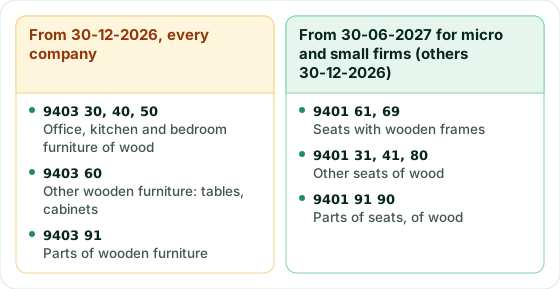
Code by code
The most common furniture cases. What counts is the customs classification of your goods, so check the code on the commercial invoice and the customs declaration:
| Product | CN code | In scope? | Date for micro and small firms |
|---|---|---|---|
| Office, kitchen and bedroom furniture of wood | 9403 30, 9403 40, 9403 50 | Yes | 30 December 2026 |
| Other wooden furniture: tables, cabinets, sideboards | 9403 60 | Yes | 30 December 2026 |
| Parts of wooden furniture | 9403 91 | Yes | 30 December 2026 |
| Seats with wooden frames, upholstered or not | 9401 61, 9401 69 | Yes | 30 June 2027 |
| Swivel and convertible seats of wood, other seats of wood | 9401 31, 9401 41, 9401 80 | Yes | 30 June 2027 |
| Parts of seats, of wood | 9401 91 90 | Yes | 30 June 2027 |
| Aircraft and motor vehicle seats | 9401 10, 9401 20 | No | |
| Furniture and seats of bamboo or rattan | 9401 52, 9401 53, 9403 82, 9403 83 | No | Bamboo and rattan do not count as wood |
| Wooden tableware, ornaments, frames for pictures | 4414, 4419, 4420 | Yes | 4414: 30 December 2026; 4419 and 4420: 30 June 2027 |
| Used and second-hand furniture | Any | No |
Large and medium-sized companies start on 30 December 2026 with all of these codes. The last column only matters if your company is micro or small.
Sourevo prepares the DDS with your suppliers’ data and submits it in TRACES. Try it free for 14 days, no card needed. Try it free for 14 days
Why furniture has no extension to 2027
The EUDR replaces the EU Timber Regulation (EUTR, Regulation (EU) No 995/2010). Its Annex already listed ‘9403 30, 9403 40, 9403 50 00, 9403 60 and 9403 90 30, wooden furniture’, the last code being the old number for wooden parts. Heading 9401 was not in that list.
Article 38(3) of the EUDR gives operators that are natural persons or micro or small undertakings, established as such by 31 December 2024, until 30 June 2027. It starts with an exception: ‘except as regards the products covered by the Annex to Regulation (EU) No 995/2010’. For wooden furniture under 9403 the date is therefore 30 December 2026 for everyone. Many small furniture importers are counting on 2027, and for tables and cabinets that is a mistake.
For seats under 9401 the general rule applies: 30 June 2027 for micro and small companies, 30 December 2026 for the rest. A small shop that imports tables and chairs from the same factory has two dates in the same container. In practice it is easier to prepare both at once, because the data you need from the factory is the same.
There is a transitional rule for old stock. Timber products that were produced before 29 June 2023 and placed on the market from 30 December 2026 stay under the EUTR rules until 31 December 2029 (Article 37). Furniture made after that date gets no such treatment. The full calendar is in the guide to EUDR deadlines.
Panels, parts, packaging and bamboo
The DDS covers the wood in the product, not only the visible solid wood. A cabinet with a solid mango frame and back panels of plywood, MDF or particle board contains wood from several sources, and the origin of each one has to be known. Plywood (4412), fibreboard such as MDF (4411) and particle board (4410) are also in Annex I when you import them as such.
Annex I does not apply to goods produced entirely from material that has completed its lifecycle and would otherwise have been discarded as waste. A board made only from recovered wood is out. If it mixes recovered and fresh wood, treat the fresh part as covered and ask the panel maker for the composition.
Bamboo, rattan and other materials of a woody nature do not count as wood (footnote to Annex I). Rattan armchairs and bamboo shelves are out. A chair with a wooden frame and a woven rattan seat is generally classified by its frame, under 9401 61 or 9401 69, and is then in. Metal, glass, stone or plastic parts are not relevant commodities.
Cardboard boxes, wooden pallets and crates that only support, protect or carry the furniture are packaging and need no DDS of their own. The same box bought empty as a product would be in. The customs codes for those exclusions are in the guide to TARIC codes on the customs declaration.
Who files the DDS
The importer that releases the furniture for free circulation in the EU places it on the market and is the operator: it submits the DDS. If the seller is outside the EU and sells goods already cleared by someone else, Article 7 makes the first person established in the EU who makes them available the operator.
If you buy furniture from an EU importer or wholesaler who already filed the DDS, you file nothing. Since Regulation (EU) 2025/2650 you are a downstream operator or a trader: you keep for five years the name, postal address and email of your suppliers and customers, and the DDS reference numbers if you buy directly from the operator. Details in the guide for downstream operators and traders.
A customs agent or freight forwarder can submit the DDS for you as an authorised representative with a written mandate, but the responsibility stays with you. See the guide for freight forwarders and authorised representatives.
Country of production: where the tree was felled
The country of production is the country where the relevant commodity was produced (Article 2(24)). For furniture that is where the tree was felled, not where the furniture was made. The Commission's FAQ says the same. An Indian factory that makes tables from teak bought in Africa or Latin America gives you a country of production outside India, and the plots and legality evidence have to come from there.
Country risk comes from Implementing Regulation (EU) 2025/1093. In low-risk countries simplified due diligence applies (Article 13): you do not run the risk assessment and mitigation of Articles 10 and 11, but you still collect all the information of Article 9, including geolocation and evidence of legality. If you learn something that points to a risk, the simplified route no longer covers you.
| Country | Risk | Usual woods | What to keep in mind |
|---|---|---|---|
| India | Low | Mango, acacia, sheesham | Many factories also work with imported wood: ask where it was felled |
| Vietnam | Low | Acacia, rubberwood | Imports a lot of wood. VPA signed, but no FLEGT licences issued yet |
| Indonesia | Standard | Teak, mahogany | FLEGT licences issued under SVLK: legality presumed (Art. 10(3)) |
| Malaysia | Standard | Rubberwood | No FLEGT licences; MyTLAS certificates in Peninsular Malaysia |
| China | Low | Often imported wood | Commission alert on relabelled Russian or Belarusian birch plywood |
In Indonesia and Malaysia, which are standard risk, you do need the full risk assessment. A valid FLEGT licence from Indonesia means the wood is considered legal (Article 10(3)), but it does not replace the geolocation or the deforestation check.
Mango, rubberwood and other orchard wood
A lot of furniture wood comes from trees that were not grown as forest: old mango orchards in India, rubber plantations in Vietnam, Malaysia or Indonesia. The definitions matter here. ‘Forest’ excludes land that is predominantly under agricultural or urban use (Article 2(4)). ‘Agricultural plantation’ covers fruit tree plantations and all plantations of relevant commodities other than wood, rubber included, and is expressly excluded from the definition of forest (Article 2(6)).
So felling an old mango orchard or a rubber plantation that was already there on 31 December 2020 is generally not deforestation, which is the conversion of forest to agricultural use. Two cautions. If the orchard was planted after 2020 on land that was forest, that conversion is deforestation. And the timber still has to have been harvested legally under the laws of the country of production, so the legality evidence is needed anyway.
Satellite data does not know about orchards. When an orchard or a plantation is cut, global maps show tree cover loss, and a forest map for 2020 can classify an old orchard as tree cover. A loss signal on a mango plot is a reason to document what the land was in 2020, not proof of deforestation. Keep the land-use record, photos or 2020 imagery that show it was an orchard. How to read these signals is in the guide to the satellite check.
Timber plantations of teak or acacia are different: they are forest. Harvesting and replanting them is not deforestation, but turning natural forest into a plantation after 2020 counts as forest degradation.
What to ask the manufacturer
For each shipment, the DDS needs the information of Article 9. In practice, ask the factory for:
- The geolocation of every plot where the wood was felled: a point for plots up to 4 ha and a polygon for larger ones, with six decimal places. Not the address of the factory or the sawmill. Formats in the guide to geolocation.
- The harvest date or period of the trees.
- The species with common and scientific name: Mangifera indica for mango, Hevea brasiliensis for rubberwood, Tectona grandis for teak, Dalbergia sissoo for sheesham, the exact acacia species. ‘Hardwood’ is not enough.
- Evidence that the wood was produced legally: land ownership or use rights, felling permits and transport documents where the country requires them, and the FLEGT licence in Indonesia.
- The quantity of each shipment in net mass and, where applicable, the number of items, with the CN code of each product.
- The same data for the panels and wooden parts the factory buys in.
The real problem is upstream. Many furniture makers buy logs or sawn timber through traders and timber depots, and by the time the wood reaches the workshop nobody knows which orchard it came from. The fix has to happen at the log purchase: the factory records for each lot the plot, the felling date and the seller, and keeps that lot traceable through the sawmill. If logs from several plots are mixed, the DDS must list every plot that may be in the shipment. Ask your manufacturer now how they will do this, because they cannot rebuild it afterwards for wood already cut.
Step by step before 30 December
A practical order for a furniture importer:
- List your products with their CN codes and mark which ones are 9403 and which 9401.
- Work out your date for each code: 30 December 2026 for 9403; for 9401, 30 June 2027 only if you are micro or small.
- Send your manufacturers the list of data above and ask for the plots of the next shipment, not of a sample one.
- Check every plot against the cutoff date of 31 December 2020 and document the orchards and plantations.
- Submit the DDS in TRACES before customs clearance and give the reference number to your customs agent.
Getting access to TRACES takes a few days, so request it now. The steps are in the guide on how to get TRACES access.
How Sourevo helps a furniture importer
Sourevo sends your manufacturer a link to a portal where they upload the plots as a GPS point or a GeoJSON file, in English or their own language (Vietnamese, Indonesian, Thai and Malay among others). Each plot is checked against satellite data, with the orchard and plantation cases marked as such and imagery from late 2020 and from today, so you can explain a loss signal with evidence. The DDS is built from that data and submitted to TRACES through its API, and the reference number comes back to you. You can try it for 14 days in the TRACES test environment. Before writing to the factory, the free GeoJSON validator tells you whether their file would pass TRACES.
Frequently asked questions
- I am a small company and only import wooden tables. Do I have until 2027?
- No. Furniture under 9403 was in the EUTR, so the EUDR applies to it from 30 December 2026 for every company, micro and small included (Article 38(3)).
- And wooden chairs?
- Seats with wooden frames are under 9401, which was not in the EUTR. For micro and small companies established by 31 December 2024 they start on 30 June 2027; for large and medium-sized ones, on 30 December 2026.
- Does rattan or bamboo furniture need a DDS?
- No. Bamboo, rattan and other woody materials do not count as wood under Annex I. A chair with a wooden frame and a rattan seat is generally classified by its wooden frame and is then in scope.
- My mango wood comes from old orchards. Is it deforestation?
- Generally not: agricultural plantations, fruit orchards included, are excluded from the definition of forest (Article 2(6)). You still need the geolocation of the plots and evidence that the wood was harvested legally, and the orchard must not have replaced forest after 2020.
- The furniture is made in India with imported teak. Which country goes in the DDS?
- The country where the trees were felled. The country of production is where the commodity was produced (Article 2(24)), not where it was processed.
- Do antique or second-hand furniture need a DDS?
- No. Every furniture line of Annex I excludes used and second-hand products.
- Do the cardboard boxes and pallets need their own DDS?
- No, as long as they only support, protect or carry the furniture. Packaging bought as a product in its own right is covered.