
 By
How to use this list
30 December 2026 is a Wednesday. From that day, a large or medium-sized company that releases for free circulation or exports a product listed in Annex I of Regulation (EU) 2023/1115 must have submitted a due diligence statement (DDS) in TRACES beforehand, and its customs broker needs the reference number for the customs declaration. Today, 19 November, there are 41 days left.
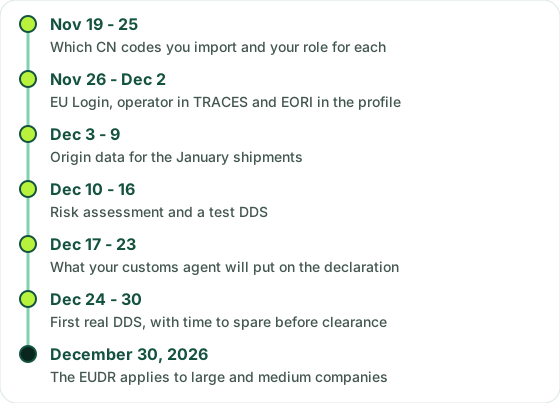
This list spreads the work over six weeks. The dates and who is caught by them are in our guide to EUDR deadlines; this piece is about the order of the tasks. We wrote it with the Regulation open and with what we have seen while submitting DDS in the TRACES acceptance environment, which rejects things the Regulation never mentions. Each week has one question and what you should have settled by the end of it.
EUDR deadline alerts by email
We only write when an application date or an EUDR rule that affects importers changes. A few emails a year, no advertising.
Who has to comply on 30 December?
Regulation (EU) 2025/2650 set the dates. The obligations of operators and traders apply from 30 December 2026. Micro-enterprises, small enterprises and natural persons that already were such on 31 December 2024 have until 30 June 2027, except for products listed in the annex of the EU Timber Regulation (Regulation 995/2010): in practice, most timber, pulp and paper. For those products, a small company starts on the same day as a large one.
Downstream operators and traders all start on 30 December, whatever their size, as shown in the timetable that Spain's environment ministry (MITECO) presented on 26 September. They do not submit DDS, but from that day they keep the details of their suppliers and customers and, if they buy directly from the operator, the reference numbers. Those that are not SMEs must also register in the Information System before selling (Art. 5(2)).
Two recent changes to Annex I, made by Delegated Regulation (EU) 2026/2102: bovine hides, skins and leather left the scope on 18 September 2026, and soluble coffee, frozen bovine tongues and a list of palm derivatives (soaps among them) came in, but only from 30 December 2027.
Sourevo prepares the DDS with your suppliers’ data and submits it in TRACES. Try it free for 14 days, no card needed. Try it free for 14 days
19 to 25 November: which codes do you import, and what is your role for each?
Make a table with every CN code you will clear or export in January and February. Next to each, three columns: whether it is in Annex I (you can look it up in the CN code checker), who places it on the EU market, and whether you clear it yourself or buy it already cleared.
Roles are decided product by product, not company by company. The same company can be the operator for the container it imports in its own name and a downstream operator for what it buys from another EU importer. For the flows where you are a downstream operator or trader, our guide to downstream operators and traders explains what to keep.
Watch the “ex” codes, where the Annex covers only part of what the code includes. In the customs declaration, goods under an “ex” code that are not covered are declared with exemption code Y129. Know now which lines will carry it and which document backs it up (composition, technical sheet).
By the end of the week: a list of flows with code, your role and the date that applies.
26 November to 2 December: are your TRACES accounts ready?
To submit you need an EU Login account with two-step verification and your company registered as an operator in the EUDR Information System. Mind the address: the EUDR has its own system (eudr.webcloud.ec.europa.eu), separate from the general TRACES NT, and its own test environment (acceptance.eudr.webcloud.ec.europa.eu). We first registered in the wrong system; it was the Commission helpdesk that sent us to the right one.
Two things to get done this week:
- The EORI number on the operator's profile. The Regulation requires it from anyone releasing goods for free circulation or exporting (Annex II and Art. 33(2)), and TRACES validation rules check it when the activity is import or export. Without it, TRACES rejects the DDS with the error EUDR-OPERATOR-EORI-FOR-ACTIVITY-MISSING. It happened to our first test import DDS.
- Web services access, if you will submit from your ERP or from a software tool. Our guide on getting TRACES access goes through it step by step.
If your freight forwarder or customs broker will submit as your authorised representative, sign the written mandate now (Art. 6). TRACES will ask them for your name, your address and at least one identifier; in our test as a representative, the address had to be split into street, postcode and city. You do not need a TRACES account to be represented, but you remain responsible for the product's compliance. See our guide for freight forwarders and customs brokers.
By the end of the week: EU Login, operator registered with EORI and, where relevant, a signed mandate.
3 to 9 December: do you have the origin data for January shipments?
What you will clear in early January is already loaded or about to be. Ask each supplier, per shipment, for:
- The geolocation of every plot, with at least six decimal places. Up to 4 hectares a single point is enough; above that a polygon is needed, except for cattle (Art. 2(28)). TRACES truncates anything beyond six decimals and rejects a point declared with more than 4 ha when the commodity is not cattle.
- The country and the date or time range of production (Art. 9(1)(c) and (d)).
- The supplier's name, postal address and email address (Art. 9(1)(e)). These do not go in the DDS, but you must keep them for five years. In the test DDS we have built from supplier documents, the item most often missing is the email.
If the plots arrive as a spreadsheet or a KML file, our GeoJSON guide with an example explains the format TRACES accepts, and the one on point or polygon when each applies.
By the end of the week: for every January shipment, plots, country, dates and supplier details received or requested in writing.
10 to 16 December: have you assessed the risk and tested a DDS?
You may only place the product on the market if your assessment finds no risk or only a negligible risk (Art. 10(1)). Country category matters. Implementing Regulation (EU) 2025/1093 classifies Belarus, Russia, Myanmar and North Korea as high risk, lists a long set of low-risk countries and leaves every other country at standard risk. The simplified procedure of Article 13 only applies if everything was produced in low-risk countries. The criteria are in our risk assessment guide.
Check each plot against the cut-off date, 31 December 2020, and write down your conclusion. A plot showing forest loss after that date has to be explained with evidence or taken out of the batch.
Then submit a DDS in the test environment using a real shipment's data. That is how you see rejections while they do not count yet. A submitted DDS stays in SUBMITTED while TRACES analyses it and moves to AVAILABLE once it receives a reference number. In our tests, statements with a few plots took about one minute, and one with several hundred polygons about three and a half minutes. The official API documentation, however, says the number may take time and recommends waiting at least one hour before retrieving it. Plan around that hour, not around our minutes.
By the end of the week: a documented assessment per shipment and at least one DDS accepted in the test environment.
17 to 23 December: does your customs broker know what goes in the declaration?
The reference number must be made available to customs before release for free circulation or export, and it is provided by whoever lodges the customs declaration (Art. 26(4)). In TARIC it is declared with document code C716; exemptions have their own codes, listed in our guide to EUDR in the customs declaration.
Agree three things in writing: who submits the DDS, how and when the number reaches the broker, and what happens if on clearance day the DDS is still SUBMITTED. In that status there is no number yet, so there is nothing to declare.
Also find out what to do if the system goes down. Implementing Regulation (EU) 2026/1565 requires the Commission to publish on a website, by 30 December 2026 at the latest, the contingency measures for unplanned outages longer than sixty minutes, which will include a contingency reference number. When it is out, send the link to your broker.
By the end of the week: the procedure with your broker in writing and one person responsible for each step.
24 to 30 December: what do you do with the first live DDS?
Submit the DDS for each shipment cleared from 30 December as soon as you have the data, not the day before. Once it is AVAILABLE you have 72 hours to amend it, keeping the same reference number, or to withdraw it; after that, only with an extension from the competent authority. Details are in our guide on amending or withdrawing a DDS.
When you sell the imported goods to another company, pass on the reference number (Art. 4(7)). Keep a record of each DDS for five years from submission (Art. 4(3)) and all due diligence documentation for five years as well (Art. 12(5)). And put the annual review of your due diligence system in the calendar (Art. 12(2)).
An example: a coffee container cleared on 12 January
Example Roasters Ltd, a medium-sized company, imports one container of green coffee from Colombia (code 0901 11): 320 bags of 60 kg, 19,200 kg net. Clearance is planned in Valencia on Tuesday 12 January 2027. The coffee comes from 14 farms: 9 under 4 ha, supplied as points, and 5 larger ones that need polygons.
| Date | What they do |
|---|---|
| 25 November | Confirm that 0901 11 is in Annex I and that they are the operator for this container. |
| 2 December | EU Login, operator registered, EORI on the profile. |
| 9 December | The exporter sends the 14 plots, the harvest period and its full details, including email. |
| 16 December | Colombia is on neither list of 2025/1093: standard risk, full assessment. They check the 14 plots against 2020 and submit a test DDS. |
| 23 December | The customs broker knows it will declare C716 with the number it receives. |
| 7 January | DDS submitted in production. It becomes AVAILABLE with its number, which goes to the broker. Until the same time on 10 January they can correct it without changing the number. |
| 12 January | Customs declaration with C716 and the reference number. |
If you want to rehearse with a real shipment, the Sourevo free trial submits to the TRACES acceptance environment, with your own test credentials or with Sourevo's test account. Plans are on our pricing page.
Frequently asked questions
- Does a shipment that left origin in November and is cleared in January need a DDS?
- Yes, if 30 December applies to you. The reference number must be available to customs before release for free circulation, and what counts is the clearance date, not the departure date.
- Can I submit the DDS before the ship arrives?
- Yes, and it is the sensible thing to do: the number must exist before clearance and TRACES takes a while to assign it. Bear in mind that the 72-hour correction window starts when the DDS becomes AVAILABLE.
- I am an SME that only buys from importers in the EU. Does 30 December affect me?
- Yes. From that day you keep the name, postal address and email of your suppliers and customers and, if you buy directly from the importer, the reference numbers of its DDS. You do not have to register in TRACES: that is only for non-SMEs.
- Can my customs broker submit the DDS?
- Yes, as an authorised representative with a written mandate. It is a different role from customs representation, even when the same company does both. You remain responsible for the product's compliance.
- Will there be another delay?
- As of 19 November we know of no published proposal. The Commission restated the dates in its announcement of 13 July 2026.