 By
What does Article 25 require of every Member State?
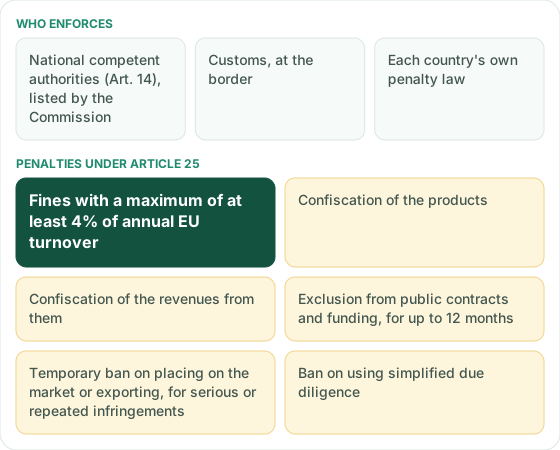
Article 25 of Regulation (EU) 2023/1115, as amended by Regulation (EU) 2025/2650, requires Member States to lay down rules on penalties applicable to infringements by operators, downstream operators and traders, and to notify those rules to the Commission. The penalties must be effective, proportionate and dissuasive, and they must include:
- Fines proportionate to the environmental damage and the value of the relevant commodities or relevant products concerned, calculated so that they effectively deprive those responsible of the economic benefits derived from their infringements, and gradually increased for repeated infringements. For a legal person, the maximum amount must be at least 4% of the operator's, downstream operator's or trader's total annual Union-wide turnover in the financial year preceding the fining decision, increased where necessary to exceed the potential economic benefit gained.
- Confiscation of the relevant products concerned.
- Confiscation of revenues gained from a transaction with the relevant products concerned.
- Temporary exclusion for a maximum period of 12 months from public procurement processes and from access to public funding, including tendering procedures, grants and concessions.
- Temporary prohibition from placing or making available on the market or exporting relevant commodities and relevant products, in the event of a serious infringement or of repeated infringements.
- Prohibition from exercising the simplified due diligence set out in Article 13, in the event of a serious infringement or of repeated infringements.
The 4% is not a fixed fine, and it is not a floor for every infringement. It is the minimum ceiling that national law has to allow for the most serious cases. The amount for each infringement is set by each country.
Member States must also notify the Commission of final judgments against legal persons, and the Commission publishes a list of them on its website with the name of the company and the penalty imposed (Art. 25(3)).
Each Member State sets its own penalty law and designates its own competent authorities (Art. 14). The next section compares where the main EU markets stand.
Which countries have already set their penalties?
Each Member State writes its own penalty law, and they are not moving at the same pace. This is where the main markets of our customers stood on 10 November 2026, according to their official sources:
| Country | National law | Authority | Fines |
|---|---|---|---|
| Spain | Draft law approved at first reading on 17 June 2025; not yet in the BOE | MITECO (Directorate-General for Biodiversity, Forests and Desertification) and the autonomous communities | To be set by the law |
| France | We found no published text setting the amounts | Ministry for the Ecological Transition and Ministry of Agriculture, jointly | Not yet set |
| Germany | Government bill (Bundestag printed paper 21/8278, 30 Sept 2026); Bundestag vote scheduled for 12 Nov 2026 | BLE; the Länder for German production | Up to €100,000, or up to 4% of total turnover for larger companies; up to 5 years in prison |
| Italy | Delegation to the Government in Art. 26 of Law 91/2025; legislative decree not yet published | MASAF | Not yet set |
| Netherlands | Law published (Stb. 2024, 242), amending the Omgevingswet; enters into force by royal decree | NVWA, with customs at the border | The law sets no new fine amount |
| Poland | Draft law UC101 (9 April 2026), still with the Council of Ministers | Veterinary, agri-food trade quality and environmental protection inspections, by commodity | In the draft: from PLN 500 up to 4-6% of turnover; 8% and 10% for repeat breaches |
| Portugal | We found no decree-law published in the Diário da República | ICNF (wood) and DGAV | Not yet set |
What does not change from one country to another is the Article 25 minimum and the measures the Regulation gives the authorities directly: holding the goods, ordering withdrawal or recall, and temporarily banning the product from the market. If you import through several EU ports, the law that applies is that of the country where you place the product on the market.
The German bill is the most detailed so far: administrative fines of up to €100,000, €50,000 or €20,000 depending on the breach, up to 4% of total turnover for companies above set turnover thresholds, criminal penalties of up to five years in prison (one to ten years where an ecosystem is seriously damaged), and exclusion from public contracts or a ban on placing on the market for up to a year. The Polish draft uses percentages of turnover from the start: from PLN 500 up to 4%, 5% or 6% depending on the breach, rising to 8% and 10% for repeat breaches within a year.
How do checks work across the EU?
Each authority has an annual plan of checks that covers at least 9% of the operators whose products come from high-risk countries, 3% when they come from standard-risk countries and 1% when they come from low-risk countries (Art. 16). Checks review the due diligence system, the documentation and the DDSs, and can include on-the-spot checks, satellite images or laboratory analysis (Art. 18).
If they find signs of a problem, the authorities can take immediate interim measures, such as holding the goods (Art. 17). If non-compliance is confirmed, they can require corrective action: withdrawing the product from the market, recalling it from customers, or donating or destroying it (Art. 24).
Any person or organisation can submit a substantiated concern about an operator to the authority (Art. 31). An NGO or a competitor with satellite images of a soya plot deforested in 2022 is a realistic starting point for a check.
How does it work in Spain, for example?
At national level, the competent authority is MITECO's Directorate-General for Biodiversity, Forests and Desertification (Dirección General de Biodiversidad, Bosques y Desertificación). Each autonomous community has also designated its own authority for checks in its territory, and MITECO publishes the list. At the border, customs checks that the declaration carries the reference number of a valid DDS and works with the competent authorities.
In June 2025 the Council of Ministers gave first approval to a draft law (anteproyecto de ley) to apply the EUDR in Spain. It creates an Office for Combating Trade-Related Deforestation as the national authority, a state commission with the autonomous communities and a state information repository. It also amends the Ley de Montes (the Forestry Act) and repeals Real Decreto 1088/2015 on legal timber.
Until that law is published in the BOE (the Official State Gazette), MITECO cites as applicable law Ley 43/2003 de Montes (the Forestry Act) and Ley Orgánica 12/1995 de Represión del Contrabando (the Anti-Smuggling Act).
What do you risk in practice?
Before any fine, the first place you feel it is customs. Without the reference number of a DDS there is no clearance, and the container waits in port running up storage charges. If the DDS exists but there are doubts about it, the goods can be held while it is checked.
Then come confiscation and withdrawal. Withdrawing a lot of coffee that has already been roasted and delivered to cafés costs far more than the coffee itself. And exclusion from public contracts hurts in sectors that sell to the public sector, such as furniture or paper.
How do you reduce the risk?
What protects you most in a check is being able to show how you decided the risk was negligible:
- Keep all the information on each shipment for 5 years: suppliers, plots, images, legality documents and the risk assessment.
- Review your due diligence system at least once a year and keep a record that you did.
- When a supplier cannot give you complete geolocation, do not submit the DDS. A delayed shipment costs less than a false DDS.
- Check plots against the cut-off date before you buy, not after the container arrives. The geolocation guide explains how.
Frequently asked questions
- Which authority checks EUDR in my country?
- Each Member State designates its own competent authorities, and the European Commission publishes the list with their contact details. Some examples from that list: in Germany, the Federal Office for Agriculture and Food (BLE); in the Netherlands, the NVWA; in Ireland, the Department of Agriculture, Food and the Marine; in Spain, MITECO's Directorate-General for Biodiversity, Forests and Desertification together with the regional authorities.
- What if my supplier gave me false data?
- Responsibility towards the authority stays with the operator. What you can show is what you did to check that data: what you asked for, what you cross-checked against images and why you concluded the risk was negligible. That is why you should document each decision at the time you make it.
- Are the national fine amounts known yet?
- Only in a few countries, and mostly in drafts. On 10 November 2026 the German bill (fines of up to €100,000 or up to 4% of total turnover) was due for a Bundestag vote on 12 November, and the Polish draft UC101 (from PLN 500 up to 4-6% of turnover) was still with the Council of Ministers. In Spain, France, Italy and Portugal the amounts were not yet published. Check the official gazette of the country where you place the product on the market.
- Who is liable if my freight forwarder submitted the DDS?
- You are. The authorised representative submits on your behalf, but responsibility for compliance stays with the operator (Art. 6). More in the guide for freight forwarders.
- Do they also check businesses that only resell?
- Yes. Downstream operators and traders have to be able to show the details of their suppliers and customers (and, for the first buyer from the operator, the reference numbers of its DDSs), and those that are not SMEs have to be registered.